Bill McKibben looked at the difference between spending twenty-four hours watching TV and twenty-four hours in the mountains. He claims that people buy simply for the pleasure of the act itself. He continues by stating in the woods there is no way to spend money. I thought this concept to be interesting, but I wanted to take it from a different angle. One can obviously see that being in the mountains brings many different sensations than watching TV. I have traveled to the Smokey Mountains a few times in my life. The atmosphere that surrounds you when hiking up a mountain is incredible. It is something you can’t receive by watching TV or by walking around town. The trees, crisp air, wildlife, and breathtaking views provide feelings of reality. When watching TV those feelings of reality dwindle because people get so lost in the TV that many times they don’t even realize people are talking to them. I’m sure there are many times after spending a day doing nothing than watch TV that you say to yourself what am I doing with my life?? Watching TV all day or for hours can make you feel lazy and unproductive. Hiking in the mountains is just the opposite you need to put forth effort in order to get anywhere. This effort that one puts forth brings a sense of accomplishment. Also one can have rewarding experiences with hiking, whereas watching TV there is not much that can be rewarding.
Another thought is the difference between watching a sport on TV compared to playing that sport yourself. Yes, you can have some appreciation about how skillful the professional players are, but not as much when you try and play it yourself. For example, I was watching tennis the other day and thought to myself those players are pretty good. The next day I went up to the tennis courts and “tried” to play tennis and realized how difficult the sport is and how much more I appreciated the professional’s talent. When you play the sport yourself one experiences fatigue, sweat, and hard work. These experiences can’t be noticed just by watching TV.
Thursday, January 31, 2008

Tuesday, January 29, 2008
Journal 4: Film and the Ancestral Environment
While reading Bormann's Holding onto Reality, I was stuck by his images concerning the 'Ancestral Environment' and the ways in which we picture this world where signs and things, knowledge and information were intimately related. This rudimentary world of natural information was one in which ancient peoples "found it necessary to realize information in some tangible and permanent way". Borgmann gives the example of how early native peoples knew information about their environment through various signs that they had learned to recognize. Borgmann sees this as a world in which there was great pleasure in being connected to reality in this intimate way.
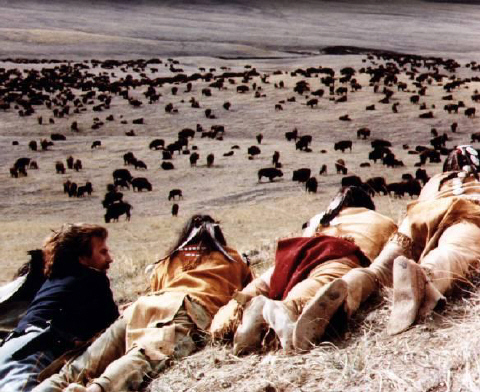
I have traveled much to the American West, and grown up around stories and movies about Native Americans and their lifestyles. One such movie comes to mind, Dances With Wolves, which has examples of native peoples living off the land and being threatened by the inevitable coming of the white man to their territory. Many of the images in my mind when I think about Native Americans comes from films such as these. No matter how historically accurate they are, however, they remain imitations of a reality I have never seen nor experienced. To me, it seems ironic that there is a serious attempt at portraying this natural world with the highest technology of film at the time (1990).
We have moved into a world so distant from the natural setting, so that although we may know what an authentic buffalo hunt looks like on film, we will never know the reality and information being presented to us if we were on a horse, trying to avoiding being trampled...we would never know the sheer trepidation and thrill of that moment; what it means to provide for your family with such unrefined means and methods. In a sense, although we see an authentic representation on television, we cannot experience the pleasure of what it must have been like to experience the real thing years ago, when the movie camera didn't even exist.
Borgmann's frame of mind is an interesting one that provides the reader with many issues to ponder and consider.
I have traveled much to the American West, and grown up around stories and movies about Native Americans and their lifestyles. One such movie comes to mind, Dances With Wolves, which has examples of native peoples living off the land and being threatened by the inevitable coming of the white man to their territory. Many of the images in my mind when I think about Native Americans comes from films such as these. No matter how historically accurate they are, however, they remain imitations of a reality I have never seen nor experienced. To me, it seems ironic that there is a serious attempt at portraying this natural world with the highest technology of film at the time (1990).
We have moved into a world so distant from the natural setting, so that although we may know what an authentic buffalo hunt looks like on film, we will never know the reality and information being presented to us if we were on a horse, trying to avoiding being trampled...we would never know the sheer trepidation and thrill of that moment; what it means to provide for your family with such unrefined means and methods. In a sense, although we see an authentic representation on television, we cannot experience the pleasure of what it must have been like to experience the real thing years ago, when the movie camera didn't even exist.
Borgmann's frame of mind is an interesting one that provides the reader with many issues to ponder and consider.
Journal # 3- “Ancestral Information”
Borgmann discusses in Chapter 3 about this thing call the Ancestral Information/ environment too some who see this word they wonder what it is and it is simple the information that is archived through nature. The different signs that nature gives us such as the example that we talk about in class with the birds nest near the water well that mean these birds live around water sources because that’s where their food sources live at. Borgmann says that “what we know of the ancestral environment and its inhabitants comes from the late and final stages of evolution, from hunting and gathering cultures that give us the earliest complete picture of the human condition. Which from what I think he is saying is that this way of gathering information, through watching nature is what late human learned how to live and basically survived. the information that I learned through hiking in the woods or going back packing through red river gorge is much more rewarding than for example getting on the computer and looking up the way the environment works. The way you learn from the environment vs. learning from a computer is two completely different things and I feel that more people need to get off the computer and go out in to nature and experience nature it self for themselves.
Borgmann discusses in Chapter 3 about this thing call the Ancestral Information/ environment too some who see this word they wonder what it is and it is simple the information that is archived through nature. The different signs that nature gives us such as the example that we talk about in class with the birds nest near the water well that mean these birds live around water sources because that’s where their food sources live at. Borgmann says that “what we know of the ancestral environment and its inhabitants comes from the late and final stages of evolution, from hunting and gathering cultures that give us the earliest complete picture of the human condition. Which from what I think he is saying is that this way of gathering information, through watching nature is what late human learned how to live and basically survived. the information that I learned through hiking in the woods or going back packing through red river gorge is much more rewarding than for example getting on the computer and looking up the way the environment works. The way you learn from the environment vs. learning from a computer is two completely different things and I feel that more people need to get off the computer and go out in to nature and experience nature it self for themselves.
The Matrix and Dreyfus
I love the first Matrix movie. Original storyline, awesome special effects, and great fight scenes. All in all a very interesting movie. But the situation in the movie is similar to the situation Dreyfus is warning us about, specifically in Ch. 3. While the character "Neo" thinks he is living in a boring normal existence, he is actually in a computer simulated virtual reality program with his body is in some sort of pod that saps the small amount of bio-electricity he produces. Is that what is going to happen to us in the future, are we simply going to be bodies in some sort of pod with our minds floating somewhere else in "cyber-space?" Now of course I don't mean literally like the Matrix with robots controlling everything and all that junk, but the basics of our minds being "plugged-in" to a computer. The idea of that is simply unthinkable, how would it be done? Do we make the decision to do it? Or is it a Government thing? And what if I choose not to do we end up with a "I am Legend" situation where there is only one man or a select number of humans still interacting with each other, nature, and earth? Or is it going to be like the Matrix where people "jump" back and forth between the real world and the fake, trying to persuade others to "disconnect?" This is a scary thought, one that can not be taken lightly.
Journal #3
Albert Borgmann's thoughts that information is taken over every inch of space in the world is soon to become reality. Every day companies come up with new ideas on how to advertise their latest product. Soon every ones car will look like the cars raced in NASCAR. Borgmann says that information has gone so far as to profane even the sacred precinct of Yankee Stadium's baseball diamond. baseball was once Americas game, people would go to the ballpark to have a quite family after-noon and interact with other people. Now theres not a second that goes by at the ballpark where there isn't some advertisement thrown into your face. Eventually i think that people will become feed up with the flood of information and stop going until things change. There isn't a place in America today where you can avoid information and its hard to relax faced with so much information. TV would be awesome if there weren't any commercials!
Journal 3
As I was reading in Borgmann, I started to think about how video games have changed over the years. Old systems like Atari were very basic, you knew it was just a game and that you weren't a little green frog trying to get to safety. As the games have evolved, the graphics have become so real that it is easy to see(although not excusable)how some people could confuse reality with a game. We seem to live in such technological age that we have forgotten that you can actually go outside and play tennis or have a boxing match with your buddy. I think video games are a great toy to play with in moderation, but I don't know that some kids realize that anything else exists. Next time the newest system comes out, instead of standing in long lines, maybe we should buy a skateboard or ball glove. Kids will continue to have technology in their lives, make them take a break for a little while and live with less technology.
Journal #2
Distance learning can be effective but it shouldn't be used. I think that someone can easily master many, but not all skills via distance learning. However, I do not think that they should be given the opportunity. Learning from a distance contributes to the problems already associated with American youth. Distance learning contributes to lack of social skills, if you could go to school in your bedroom why would you ever leave and interact with people.
Distance learning also contributes to laziness. If you don't have to physically get up and go to class you probably won't get up to do anything during the day. Traditional learning also builds responsibility, you have to follow a routine to be successful. Distance learning doesn't require responsibility. Therefore i believe distance can be effective but there are more important skills that must be mastered before distance learning can be incorporated and not take away from the maturation of Americas youth
Distance learning also contributes to laziness. If you don't have to physically get up and go to class you probably won't get up to do anything during the day. Traditional learning also builds responsibility, you have to follow a routine to be successful. Distance learning doesn't require responsibility. Therefore i believe distance can be effective but there are more important skills that must be mastered before distance learning can be incorporated and not take away from the maturation of Americas youth
Journal 2
In the first chapter of Borgmann's book he talks about the decline of meaning and the rise of information. Today's world is bombarded with so called inforemation. One cannot turn on a computer, television, or radio without hearing some advertisement for a particular product. One can't drive down the roaf without seeing signs either. I think for some people, these signs make them want to go out and buy the newest and best products. They don't want to be behind their neighbor. But I think a lot of others just want them to go away or they try to ignore them. We have do not call lists to ward off telemarketers, pop up blockers on computers, recycle bins for junk mail, and many other things in place to try to keep unwanted advertisement in our lives. With so much out their how does a person know if it is truthful or a scam. It is too bad that society has gotten to the place where it is very hard to tell what information is real and meaningful
Journal #1
Dreyfus's views on the quality and efficiency of online search engines are almost exactly in line with my views on the subject. There is almost no possible way given our current AI capabilities that a successful internet search using engines, such as google, dogpile or yahoo is feasible. Millions of pages are added each day and probably near the same amount are deleted but despite this, due to success of other technologies, we expect instant quality results when we hit the search key. I know for a fact that I'm not the only person in the world who gets aggravated by a piss poor search. None the less thousands and thousands of students are steered to the internet by librarians and teachers, who's to blame? Probably society, people are raised to do everything as efficiently as possible, no matter how bad the quality.
Journal #3 - Borgmann
There were a few lines that caught my eye in the introduction of Borgmann's book. "Is my ethereal Internet self the genuine me, freed from the accidents of my place, class, and looks? Or is it a flimsy and truant version of what, for better or worse, I am actually and substantially?" Although I think the answer to these questions vary from person to person I am constantly wondering about the "realness" of the people I chat with online. How genuine are they? How genuine am I? Yes, the Internet frees us from the physical limitations imposed upon us...but aren't those limitations factors in making us who we are? And if so, then the Internet can't really free us from them, it just allows us to pretend they don't exist for awhile...lie to ourselves and others. Or does the Internet provide us with an interactive fairy tale...allowing us to leave boundaries behind and explore using our imagination as the navigation device. In that sense, how can it be bad? Maybe it is a matter of finding balance between the two extremes. I don't think the question as to the "realness" of one's Internet self can truly be answered in a short blog entry but it definitely gives me something to think about.
Monday, January 28, 2008
Journal Entry 3
Last thursday in class, we discussed how techique is a way of organizing the world that we live in. In the book, borgmann discussed how cognitive information is focus for phyisology, psychology, and cognitive science. In the age of technology, the tool have their own justification. The raising issue today is that should the government regulated certain technological advances?
I believe that the government make regulations including biotechnology. One of my reasons is that biotechnology can get in the hands of the wrong people and they can use it as a threat to the country.
In the book, Borgmann mentioned if information and reality can coexist with each other. In order to answer that question you have to explain the kinds of information. Natural information is about reality which consists of signs. We as human beings are living in a world can realize certian objects, you have obtain information economy of sign and presence. Cultural information is information for reality. This allows you to do or make something. According to Borgmann, the new way of thinking can threatens information.
I remember in the class, we concluded that the way of people used language is damaged by computers. Today, more and more adsolescents are giving worse in grammar and spelling due to text messaging, instant messaging, and facebook. Although replacing some words such as "you", "are", and "the the with "u", "r", and "da" is good when saving money and time on text messages, it cause people to write or type in unintelligent language. Another consequence is that it increase the nation's illiteracy rate.
I believe that the government make regulations including biotechnology. One of my reasons is that biotechnology can get in the hands of the wrong people and they can use it as a threat to the country.
In the book, Borgmann mentioned if information and reality can coexist with each other. In order to answer that question you have to explain the kinds of information. Natural information is about reality which consists of signs. We as human beings are living in a world can realize certian objects, you have obtain information economy of sign and presence. Cultural information is information for reality. This allows you to do or make something. According to Borgmann, the new way of thinking can threatens information.
I remember in the class, we concluded that the way of people used language is damaged by computers. Today, more and more adsolescents are giving worse in grammar and spelling due to text messaging, instant messaging, and facebook. Although replacing some words such as "you", "are", and "the the with "u", "r", and "da" is good when saving money and time on text messages, it cause people to write or type in unintelligent language. Another consequence is that it increase the nation's illiteracy rate.
Technology vs. Reality--The Epic Battle
In one corner, we have reality, which is...well...what is real. Tangible things. Natural information and cultural information fall within these categories. We can see nature. We can hold a leaf in our hand. We can see culture. We can hold our cultural symbols in our hand and embrace our language. In the other corner, we have technology. Uh oh. While we can hold gadgets, we cannot really encompass the idea of technology. "If technology can progress, it will progress" with or without the human race (according to some).
Borgmann sees technology as a threat to natural and cultural information--that technology will wipe out these two altogether. If you think about technology from a gamer's perspective, isn't that what the creators want? To build an entire virtual reality? Another world where one can escape the mundane, day to day, business suit and strap on some leather armor and defeat a mighty dragon. I don't believe that virtual reality will ever be able to overtake the "real" reality. But people can use it to escape from this world and enter another...
Borgmann sees technology as a threat to natural and cultural information--that technology will wipe out these two altogether. If you think about technology from a gamer's perspective, isn't that what the creators want? To build an entire virtual reality? Another world where one can escape the mundane, day to day, business suit and strap on some leather armor and defeat a mighty dragon. I don't believe that virtual reality will ever be able to overtake the "real" reality. But people can use it to escape from this world and enter another...
Journal Entry 3
In Borgmann's first few chapters, he discusses the idea of information. He states that information can take many different states and there are multiple types of information. One thing Borgmann pointed out that was interesting to me was when he mentioned that the internet allows us to constantly be bombarded with information, but even without the internet, we are still always having information thrown at us from television, music, billboards, advertisements and so on. Another interesting point and almost alarming thing that he points out in his introduction is the fact that people today can often feel closer with someone down the hall by sending an e-mail than to a person right next to them within talking distance. It's disturbing to think that a technological connection with a person can engage two people better than the good old-fashioned way of physically carrying on a conversation face-to-face.
Borgmann then goes on to question the structure of information. He askes the question of whether having information is the same as "knowing" something. He then goes on to further break it down by stating that there is indirect knowledge and direct knowledge. Direct knowledge is directly knowing or experiencing something, while indirect knowledge is learning it indirectly and not actually experiencing it yourself but second hand. He goes into the idea that there is natural information and cultural information. Natural information is "about" reality; signs connect us to our natural environment. Cultural information is "for" reality.
I also agree with Borgmann when he talks about our language and how it is becoming "shapeless." Today, so many people use text, instant messaging, e-mail, myspace and facebook and it's easy to fall into the mode of "short-hand" or "slang." In my personal experience, I'm used to abbreviating some things on text and at times, when I have to actually write those words out on paper, I will catch myself wanting to write the "text" version, which is scary. One would think that as our means of communicating and use of technology grew, we would also have to grow intellectually with it to understand it, but I believe that some people today are hindered by the short-hand and have actually lost some of their knowledge of how to write things correctly; not many people ever use proper capitalization, grammar, or spelling rules over text.
Borgmann then goes on to question the structure of information. He askes the question of whether having information is the same as "knowing" something. He then goes on to further break it down by stating that there is indirect knowledge and direct knowledge. Direct knowledge is directly knowing or experiencing something, while indirect knowledge is learning it indirectly and not actually experiencing it yourself but second hand. He goes into the idea that there is natural information and cultural information. Natural information is "about" reality; signs connect us to our natural environment. Cultural information is "for" reality.
I also agree with Borgmann when he talks about our language and how it is becoming "shapeless." Today, so many people use text, instant messaging, e-mail, myspace and facebook and it's easy to fall into the mode of "short-hand" or "slang." In my personal experience, I'm used to abbreviating some things on text and at times, when I have to actually write those words out on paper, I will catch myself wanting to write the "text" version, which is scary. One would think that as our means of communicating and use of technology grew, we would also have to grow intellectually with it to understand it, but I believe that some people today are hindered by the short-hand and have actually lost some of their knowledge of how to write things correctly; not many people ever use proper capitalization, grammar, or spelling rules over text.
Week 3 Entry
In the beginning of his book, Borgman discusses wat he sees as the 3 types of information. He discusses how the first two types, natural and cultural, build upon each other, enhance each other, and inform each other. However, he observes that the third type of information, technological, does not follow the same pattern. He argues that technological information has begun to replace or become reality, instead of informing or enriching reality as the other 2 types do. He believes that we have begun to replace reality with technilogical information. We would rather look at a website about te natural world than actually go outside and experience it, or at least Borgman fears that we will soon if we follow the path we are on now. It was brought up in class that his fear of this happening is unnecessary because the natural world will always be there for us to see if we wish to experience it. However, I believe that Borgman has a valid point. His fear is not that our technology will destroy the natural world, but that it will remove our desire to experience nature when we can look at pictures of it from the comfort of our own homes. I have to admit that as time goes on, I spend more and more time on my computer, and less time outdoors just enjoying nature. Borgman's fear of nature being replaced by the world of technological information , in my opinion, is a very valid one.
Technology vs. Reality
In his book Holding on to Reality, Borgmann claims that his main goal is to find a balance between technology and reality. However, I am not sure such a balance exists. Isn’t it one of technology’s purposes to create a place with few inhibitions and an incredible scope – the exact opposite of reality?
For example, movies were first designed to entertain. They had no deep, philosophical messages to pass down from generation to generation. Filmmakers just wanted to experiment with moving pictures. The camera was just a new gadget with which to play. However, as technology improved so did the seriousness of the pictures. Instead of just entertaining their audiences, movies began to express and analyze reality. Nevertheless, the reality shown in the movies was mostly an exaggeration. Truly, how many people experience such events like those found in, for instance, Love Actually or Say Anything?
Honestly, I find it difficult to believe that any sort of balance between the influx of information technology and reality can be achieved however much one wishes it to happen.
For example, movies were first designed to entertain. They had no deep, philosophical messages to pass down from generation to generation. Filmmakers just wanted to experiment with moving pictures. The camera was just a new gadget with which to play. However, as technology improved so did the seriousness of the pictures. Instead of just entertaining their audiences, movies began to express and analyze reality. Nevertheless, the reality shown in the movies was mostly an exaggeration. Truly, how many people experience such events like those found in, for instance, Love Actually or Say Anything?
Honestly, I find it difficult to believe that any sort of balance between the influx of information technology and reality can be achieved however much one wishes it to happen.
Cyborgs?
Through our discussion concerning “The Technique”, I gradually noticed the extent to which technology has shaped my life as well as the extent to which it has become an irreplaceable part of it. I cannot imagine living a life with no internet or iPod, let alone electricity. However, it was not so long ago that these things did not exist.
It makes me wonder if I could live without these technological inventions that have become so enmeshed in my life that one could call them necessary to survival. Could I spend a week in silence with no “background noise” to keep me focused and occupied? Has technology become so much a part of myself that I could be called a cyborg?
The answer to both of these questions is…I don’t know. I don’t know if I could spend a week in silence because silence is so hard to acquire in an age where advertisements scream at you from every corner. I don’t know if I could live without the comforts of technology. Perhaps, I am a cyborg in some sense of the term. Perhaps, technology has moved from just being our environment to being an irreplaceable part of our selves.
It makes me wonder if I could live without these technological inventions that have become so enmeshed in my life that one could call them necessary to survival. Could I spend a week in silence with no “background noise” to keep me focused and occupied? Has technology become so much a part of myself that I could be called a cyborg?
The answer to both of these questions is…I don’t know. I don’t know if I could spend a week in silence because silence is so hard to acquire in an age where advertisements scream at you from every corner. I don’t know if I could live without the comforts of technology. Perhaps, I am a cyborg in some sense of the term. Perhaps, technology has moved from just being our environment to being an irreplaceable part of our selves.
Oh, technology...
As I read the textbooks and listen to the class discussions, I find it increasingly more difficult to form an opinion about technology and it influences, beneficial or disastrous, on society and humanity. I find myself agreeing with both the opinions of the philosophers who claim that technology is taking over our lives as well as with those in our class who say society is using technology as a scapegoat. However, I am certain of one thing – the idea of technology is better, although not necessarily more advantageous, than the actual creation of such technical gadgets as the internet and the computer.
The idea of technology as an easier, faster, more available means of obtaining knowledge is rather…limited. Without doubt, technology has achieved these goals and looks to improve even more in the coming years. However, at what cost? Has our desire for an easier, quicker, more connected world and the invention of such objects to achieve this goal, actually hindered and isolated us from each other?
I do not think the answer can be a simple yes or no. If I answer yes, I feel a little medieval. If I answer no, I feel rather exposed. In short, I do not think we can determine whether technology is “good” or “bad”. It exists, and we must deal with the consequences.
The idea of technology as an easier, faster, more available means of obtaining knowledge is rather…limited. Without doubt, technology has achieved these goals and looks to improve even more in the coming years. However, at what cost? Has our desire for an easier, quicker, more connected world and the invention of such objects to achieve this goal, actually hindered and isolated us from each other?
I do not think the answer can be a simple yes or no. If I answer yes, I feel a little medieval. If I answer no, I feel rather exposed. In short, I do not think we can determine whether technology is “good” or “bad”. It exists, and we must deal with the consequences.
Week 2 Entry
Dreyfus makes a lot of valid points about distance learning and traditional learning. I agree with his belief that distance learning could never fully replace traditional methods of education. Dreyfus maintains that in the 6 stages of learning, distance learning could never allow a student to get past the stage of competence. Dreyfus argues that past this point, the learner must have a real emotional investment in learning the material that is not possible in distance learning. He also maintains in order to truly master any subject, one must follow, and study other masters of the subject, laerning their styles until you eventually formulate your own style. Tis would be entirely impossible to do with distance learning. Thus according to Dreyfus, replacing traditional education entirely with distance learning would produce a world in which there are no experts in any fields, and no true masters of anything. Advocates of distance learning would argue that these would be possible through telepresence. They argue that a classroom setting could be simulated in which the students could view lectures live via the internet, and the techer could view the students in the same manner, but Dreyfus disagrees. He argues that not only could this not create a good enough situation forthe student to learn sufficiently, but it could not create a suitable situation to teach in. Dreyfus argues that taechers would have no feel for the classroom, the mood of teh students, or any sense of the class's interst in waht is being taught. It would lead to lectures being dull and difficult to pay attention to because the teacher would have no way of guaging the interest of the students, and would not have any way to alter it.
I have to agree with Dreyfus's stance on distance learning. As a biology major, I have had 2 different science labs every semester so far in my 3 years at school here. I can certainly say that the laboratory exercises make it much easier to learn the material being taught in the lectures, as it provides a visual example of the things being covered in the class. Being able to see and physically participate in the laboratory exercises is sometimes even more helpful than being physically present in the lectures to here explanantions of the physical, chemical, or biological systems. Distance learning could not provide the kinds of opportunities like this that can be greatly important in a person's education. This is just a more specific example that expresses the point that Dreyfus makes about the limits of distance learning.
I have to agree with Dreyfus's stance on distance learning. As a biology major, I have had 2 different science labs every semester so far in my 3 years at school here. I can certainly say that the laboratory exercises make it much easier to learn the material being taught in the lectures, as it provides a visual example of the things being covered in the class. Being able to see and physically participate in the laboratory exercises is sometimes even more helpful than being physically present in the lectures to here explanantions of the physical, chemical, or biological systems. Distance learning could not provide the kinds of opportunities like this that can be greatly important in a person's education. This is just a more specific example that expresses the point that Dreyfus makes about the limits of distance learning.
Journal 3
I had a much harder time understanding Borgman because of his analogies and metaphors that he used to express his point. Many just seemed irrelevant to any topics discussed in the classroom and some were just stretched out too far. What I got from the reading was the part concerning how we as humans use three types of information; natural, cultural, and technological (which we also discussed in lecture). Like Dreyfus, Borgman assumes the role as the pessimist who feels that technology is “replacing” former aspects of our lives and environment. He assumes that we will lose touch with nature and culture, and instead focus all available attention to the technological. Borgman calls for a balance, which I like because it’s less pessimistic, but it’s not quite as necessary as he makes it out to be. Natural and cultural information are important and although they are sometimes looked over for the easily accessible technological information, it does not mean that they are fading away completely. Information can be affectively acquired by means of technology, but not as far in depth as cultural or natural information can provide for us. Basically, if you desire that greater understanding of it, you will seek it. We have free will and more control than Borgman would want you to think. So, “where can one go to experience pure silence, without the roar of technological information?” Not far really; probably your own house. Most technological devices have an off switch, you know? If you really don’t want to receive any calls, emails, watch TV, listen to music, or be bothered by any other “roaring” and intrusive technologies, I suggest you stay home and turn everything off. Technology’s all around us, but usually the most intrusive ones that directly affect your personal space and privacy (phones, computers, TV’s, Mp3 players) can be avoided with some will-power. Who’s to say what’s real and what’s not anyway? Technology is real just like nature and culture. It’s just grows more complex and flexible over time to the point where some inevitably develop pessimistic a point of view like Borgman’s here.
Sincerity and Technology
Dear Fellow Bloggers:
Last class we discussed the decline of formal conventions involved in writing a letter with the advent of email, instant messaging and text messaging, one of which is including "Sincerely," at the end of a letter. Well, I happened upon a very interesting article about the sincerity of contemporary poetry in the February issue of Poetry. And it got me thinking about sincerity on the internet. In this article, the author quotes Robert Frost, whom I sincerely hope you are all familiar with.
"There is such a thing as sincerity. It is hard to define but it is probably nothing more than your highest liveliness escaping from a succession of dead selves. Miraculously. It is the same with illusions. Any belief you sink into when you should be leaving it behind is an illusion. Reality is the cold feeling on the end of the trout's nose."
I just love that phrase: "your highest liveliness escaping from a succession of dead selves. Miraculously." Now miracles are something that technology will never understand, and I think Frost's phrasing here is perfect for our discussion of things like facebook and myspace--you can never be sincere in an artificial space because such a page is a veritable collection of corpses, of "dead selves." The moment you've posted something posted something on facebook, it's already dead to you, isn't it? It's certainly not your highest liveliness--how could it be? It's just pixels or words--nothing real. Also, I think Borgman would appreciate Frost saying that "reality is the cold feeling on the end of trout's nose." Definitely natural information.
The internet severely lacks sincerity. Everything that springs from the internet is a mockery of itself--the internet itself is one of the favorite things to poke fun at--not that it doesn't deserve it. It's really hard for me, personally, to take anyone very seriously who says "lulz" even occasionally. As far as I can see, the internet makes a parody of everything: I don't think I've ever witnessed a tragedy involving the internet. Even things that were once tragedies become parodies on the internet.
Sincerely,
Hank Backer
Subscribe to:
Posts (Atom)